

Research
Shrimp Welfare Project engages in numerous research projects, allowing us to investigate key questions and turn evidence into real-world solutions for the industry.

We collaborate with academic researchers, policymakers, and certifiers to catalyze evidence-based standards and fill the “welfare gap” in the scientific literature.
Latest Research:
Read the University of Stirling study comparing electrical stunning vs. ice slurry
Peer-reviewed and published in 2026 in the academic journal “Aquaculture”
Ongoing & Recent Projects:
University of Stirling Study (2026): We’re currently part of a multi-year study led by the University of Stirling measuring the neurological activity and behaviour of shrimp during harvest. As part of the consortium with industry partners, we support peer-reviewed science into effective stunning methods. The study found neural insensibility was faster after electrical stunning than cold shock. Read more
ASC Technical Working Group: We’ve participated in the Aquaculture Stewardship Council’s Technical Working Group for shrimp welfare since 2023, helping strengthen evidence-informed welfare requirements. In 2025, the ASC Farm Standard recognised electrical stunning as an acceptable method of stunning for shrimp. Read more
Humane Stunning White Paper (2026): While academic studies are ongoing, we commissioned a researcher to conduct a literature review of what the available science says about the effectiveness of electrical stunning, compared to chilling methods. Read more
Wild-Caught Shrimp Welfare: Our Research and Policy Lead, Shannon Davis, co-authored Shrimp and Prawn Welfare in the Wild-Caught Fishing Industry (2025), synthesizing the evidence on welfare in wild-capture and mapping recommendations to reduce suffering at scale. Read more
Nephrops Study: We helped fund the design and sea-trial of the world’s first onboard stunning-and-tailing prototype machine for wild-caught nephrops (langoustines), supporting humane slaughter for decapod crustaceans. Read more
We’re also involved in confidential research initiatives with academic and industry partners to test and refine humane slaughter methods, generating more field-relevant data and developing practical solutions for producers.
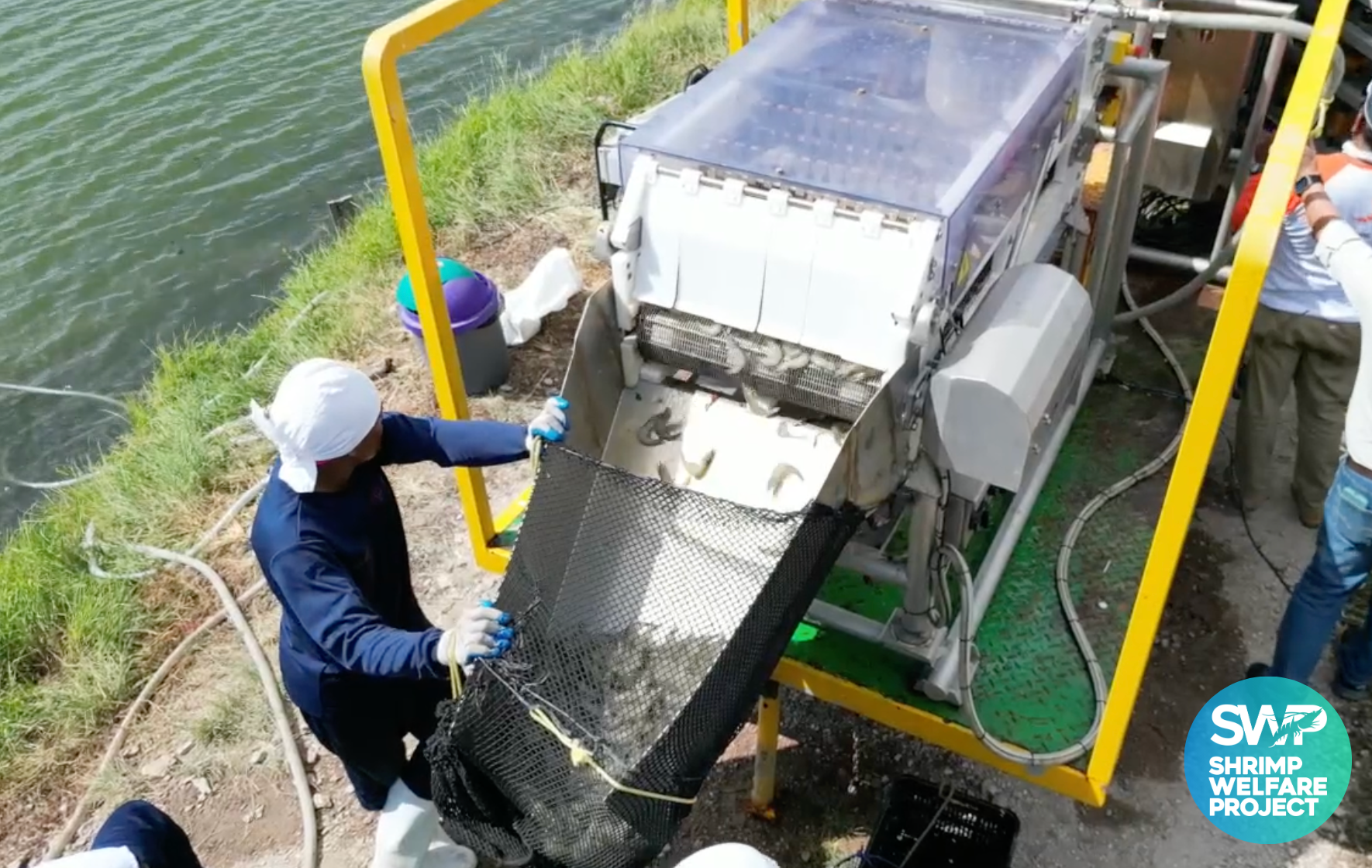
On-Farm Data Gathering
Through the Humane Slaughter Initiative, we have team members present at every stunner installation, and provide ongoing technical guidance to ensure producers are supported on-the-ground.
We measure various parameters to assess the effectiveness of electrical stunning, including equipment settings, on-farm conditions, harvest protocols, and indicators of shrimp welfare. We also conduct case studies and survey producers to gather real-world data that can improve our initiative.
With this research-backed approach to our field work, the Shrimp Welfare Project team is developing a knowledge base that can identify solutions for each unique farm context.
Our Reports
Assessing Humane Stunning Methods for Shrimp
A Review of Electrical Stunning and Chilling
This report synthesises behavioural, physiological, and electrophysiological evidence on two stunning practices of decapod crustaceans: chilling, due to its widespread use, and electrical stunning, due to its growing prevalence as a potentially more humane alternative.
Published February 2026
Shrimp Welfare Index
The most important factors to good farmed L. vannamei welfare
This index is an initial attempt to capture and address the most important factors to good farmed L. vannamei welfare that are based on a review of the most current peer-reviewed literature.
Published April 2024
Shrimp Welfare Report
Factors Affecting Shrimp Welfare in Aquaculture
This report aims to assess the importance of various factors for the welfare of farmed shrimps, with a particular focus on Litopenaeus vannamei.
Published November 2022
Consumer Attitudes Towards Shrimp Welfare
An exploratory research study
This exploratory study examines consumer attitudes towards the moral worth and welfare of shrimps and willingness to pay more for higher welfare animal products.
Published September 2023
The Alternative Shrimp Market
Major Players and Investors, Challenges, and The Way Forward
This report provides an analysis of the alternative shrimp market, discussing its growth, current status, and the challenges it faces.
Published November 2023
Vietnam Scoping Report
What are our findings after having visited eleven shrimp farms in Vietnam?
This report discusses the welfare of shrimps, why we chose Vietnam as a scoping country and our findings after having undertaken water quality measurements on shrimp farms and discussions with several stakeholders in the shrimp supply chain.
Published March 2023
India Scoping Report
Our findings after speaking to more than two dozen stakeholders in the shrimp farming industry
This report discusses the welfare of shrimps, why we chose India as a scoping country and our findings after having undertaken water quality measurements on shrimp farms and discussions with several stakeholders in the shrimp supply chain.
Published April 2022
Shrimp Paste and Animal Welfare
An overview of the shrimp paste industry
This scoping study provides foundational information on the suffering of Acetes shrimps harvested for the shrimp paste industry.
Published April 2024
Welfare and Profitability
Our pilot study for sustainable stocking densities
This pilot study compares two different stocking densities, showing that reducing stocking density does not translate to reduced profits in the same proportion.
Published May 2023
Supply and Demand Impacts
How a reduction in stocking density could reduce animal suffering
This report estimates the effects of a reduction in stocking density on the total number of shrimps produced and the total number of days of animal suffering.
Published October 2023

Find other resources that are useful for understanding Shrimp Welfare here.